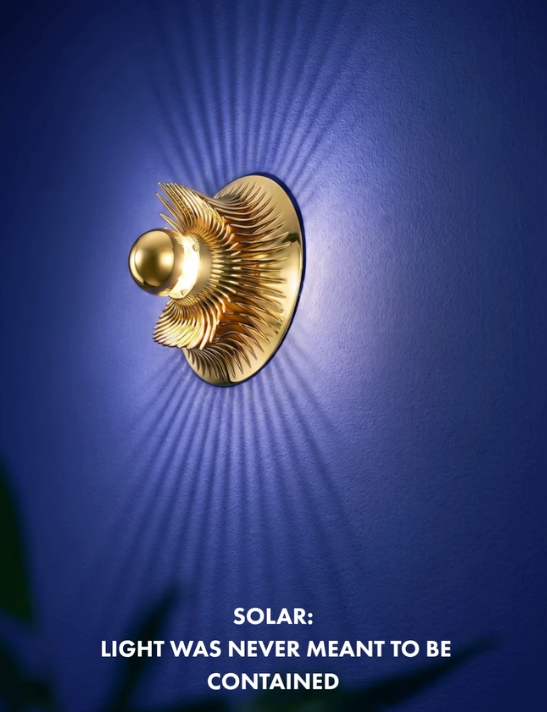
Solar, designed by Ramona Albert Design, is a sculptural lighting concept whose radial geometry creates dramatic patterns of light and shadow. For this project, Kinzi was engaged to develop and manufacture the prototype — translating a highly complex digital form into a physical cast object.
The challenge was not simply to make a part to a drawing. The prototype required a manufacturing process developed specifically around the geometry of the design, combining modern prototyping technology with the care and precision of skilled hand craftsmanship.

From Digital Geometry to a 3D-Printed Master Pattern
Kinzi began by producing a 3D-printed master pattern for the casting process. This allowed the intricate radial geometry and narrow spaces between the fins to be reproduced accurately before moving into investment casting.
The master pattern was not treated as a conventional model. Every surface and transition had to be carefully prepared because any imperfection at this stage could be transferred into the ceramic shell and ultimately appear in the final casting.
Building the Ceramic Shell for Fine Geometry
One of the most critical stages was the ceramic shell preparation. The Solar prototype contains narrow gaps and tight recesses that are difficult for conventional shell materials to reach consistently.
Kinzi therefore carefully selected fine, consistently graded refractory particles for the shell-building process. The particle size needed to be small and uniform enough to enter the narrow spaces around the geometry and reproduce the fine details of the master pattern.
This step required close control and patient, hands-on work. The quality of the shell surface directly influenced the quality of the cast component.
A Casting System Developed Specifically for the Prototype
The geometry also required a dedicated melting, gating and metal-flow strategy. Rather than applying a standard casting arrangement, Kinzi developed the casting method around the form of the prototype so that molten metal could reach the thin sections and complex transitions of the component as effectively as possible.
The prototype therefore became a manufacturing study in its own right — requiring both casting engineering and practical foundry experience to make the design physically achievable.
Hand Finishing the Cast Surface
After casting, the process returned to craftsmanship. Each surface required careful grinding, correction and hand finishing, particularly around the narrow gaps and delicate transitions between the fins.
The objective was not simply to remove casting marks. The team had to refine the surface while preserving the original geometry and preparing the component for its final decorative finish.
This stage demanded the same kind of patience and attention normally associated with handcraft — every area was treated individually rather than relying only on automated finishing.
Where Engineering Meets Craftsmanship
The Solar prototype demonstrates a side of Kinzi’s capability that cannot be defined by machinery alone.
3D printing created the master pattern. Engineering made the casting possible. Craftsmanship brought the prototype to life.
From ceramic shell preparation and particle selection to casting-process development and meticulous hand finishing, the work required a combination of technical knowledge, process development and skilled manual workmanship.

Project Details
Design: Ramona Albert Design
Project: Solar Prototype — The Architecture of the Intimate
Application: Sculptural Architectural Lighting Prototype
Material: Stainless Steel
Process: 3D-Printed Master Pattern / Investment Casting / Surface Preparation / Hand Finishing
Kinzi Scope: Prototype Development, Casting Process Development, Investment Casting & Hand Finishing
Solar shows how Kinzi can support designers at the prototype stage by developing a practical manufacturing route for forms that are difficult to produce through conventional methods.